
Image by @AlstonGodbolt
If you want YouTube income that feels less like gambling and more like a real business, the winners in 2026 are the monetization models you control, not the ones controlled by algorithms, advertisers, or random brand managers.
Every year, creators get pitched the same dream: upload videos, collect AdSense, land a few sponsors, and coast into passive income. It sounds nice. It also sounds like something a whiteboard loves more than a bank account does.
We have recently tested 10 different YouTube monetization strategies and ranked them using four practical filters: speed to first dollar, income control, profit margin, and repeatability. That framework matters because most monetization advice forgets one brutal truth: not all revenue is good revenue.
Some income comes fast but eats your time alive. Some looks passive but depends on platforms changing rules whenever they feel spicy. And some models are ridiculously powerful because they let you keep the pricing power, the customer relationship, and the margin.
The biggest takeaway from the test is simple. In 2026, the winning monetization strategies are not the flashiest ones. They are the ones that turn your YouTube channel into the front door of a business.
Why AdSense and Sponsorships Are Not the Main Character
Before we get to the top five, it is worth saying the quiet part out loud. AdSense is fine, but it is not a business model by itself for most creators. You need YouTube approval, your payouts can fluctuate wildly, and you have almost no control over RPM, seasonality, demonetization, or audience geography.
Sponsorships are also less dreamy than they look on creator Twitter. They can pay well, but they usually come after you build some size, and many brands still want a premium result at a discount-bin rate. That is not partnership. That is coupon-code cosplay.
The video ranks both of these relatively low, and that makes sense. They can be valuable later, but they are weak foundations if you are just trying to build dependable income.

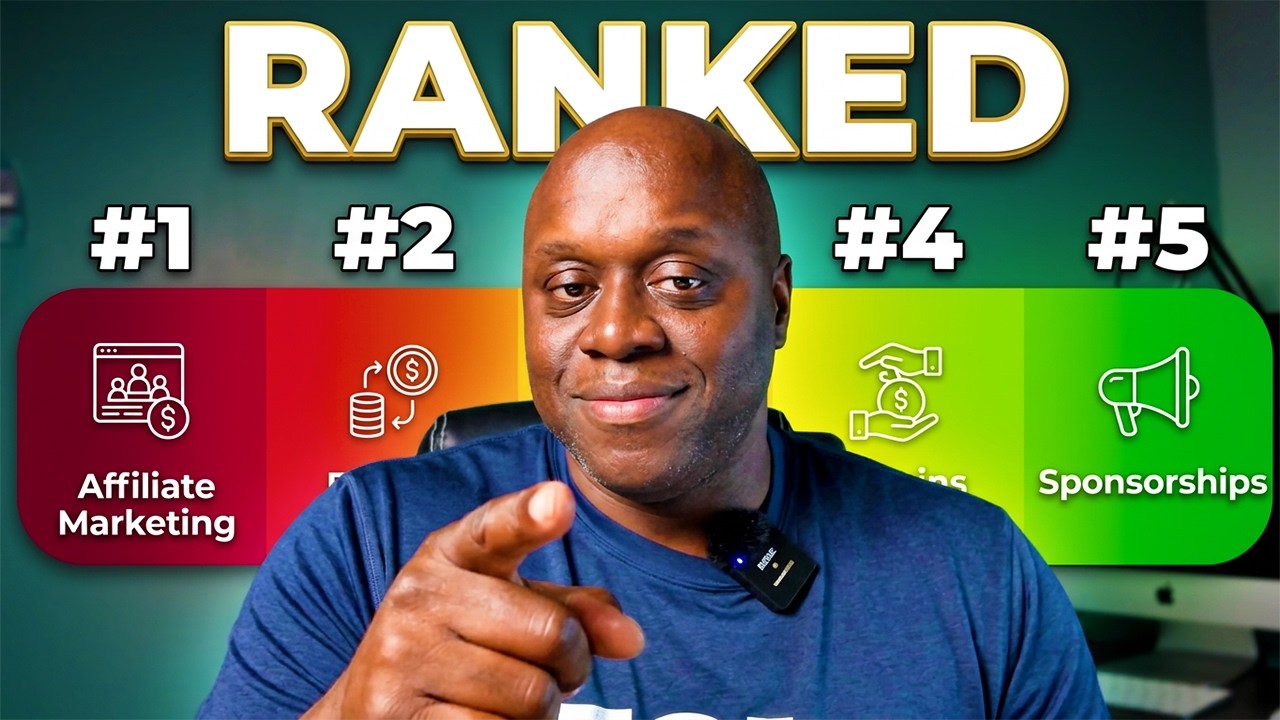
The Ranking: Best YouTube Monetization Models for 2026
| Strategy | Why It Works | Main Tradeoff | |
|---|---|---|---|
| 1 | Digital Products | Fast to launch, high margins, scalable, easy to repeat | Requires testing to find what sells |
| 2 | Mini Course or Workshop | Blends live value, urgency, and strong pricing power | Needs your time and live delivery |
| 3 | Membership Community | Recurring revenue and deeper audience relationship | Ongoing content and retention effort |
| 4 | Coaching | Can monetize immediately with expertise | Limited by your hours |
| 5 | Services | Fast cash and direct proof of market demand | Labor-heavy and harder to scale alone |
5. Services: Fast Cash, Strong Validation, Limited Freedom
Services take the number five spot because they work quickly. If you already have a useful skill like video editing, website design, copywriting, branding, thumbnail creation, or automation setup, YouTube can become your lead engine almost immediately.
The beauty here is not just cash flow. It is validation. When someone watches your content and then hires you, the market is telling you your knowledge has value. That signal is huge.
The catch is that services are still time-for-money. You can earn fast, but every new client wants your calendar, your attention, and your energy. That makes services a great launch model, but not always the ideal long-term model unless you later productize or outsource delivery.
4. Coaching: High Control, High Margin, High Human Energy
Coaching ranks fourth because it is one of the fastest ways to turn attention into money. You do not need a giant audience. You need trust, clarity, and a problem you can help solve.
That is the magic of coaching on YouTube. Your videos do most of the pre-selling. By the time someone books a call, they already know your style, your thinking, and whether they want your help.
The downside is obvious. One-to-one coaching does not scale elegantly. It scales like a very smart backpack. Useful, profitable, and eventually heavy.
Still, coaching is excellent if you want a fast cash infusion, market feedback, and a direct way to discover what your audience is really struggling with. Those same questions can later become workshops, memberships, or products.
3. Memberships: The Monthly Revenue Machine
Membership communities hit a sweet spot that a lot of creators miss. Instead of waking up every month at zero and trying to hustle your way back to an income target, you start with recurring revenue already on the board.
That changes the psychology of the business. It also changes your margin for error. A good membership gives you stability, closer access to your audience, better feedback loops, and a customer base that can buy additional offers later.
The tradeoff is retention. A membership is not just a payment button. It is a promise. If people keep paying, they expect ongoing value, conversation, access, or accountability. If the experience gets stale, churn shows up like an unpaid intern with bad news.
Still, for creators who can lead a niche community, this model is incredibly attractive in 2026 because it combines relationship depth with recurring revenue.
2. Mini Courses and Workshops: The Most Underrated Middle Ground
The video places live mini courses and workshops at number two, and honestly, that feels right. This is one of the most underrated offers in the creator economy.
Why? Because workshops solve a specific problem fast. They feel more focused than a giant course, more scalable than one-to-one coaching, and more immediate than waiting for a community to mature. They also create urgency. People are much more likely to buy something with a clear result and a real date attached to it.
The creator mentions charging around $49 for workshops, which is a smart middle-ground price point. It is accessible enough for a YouTube audience and high enough to signal value.
Even better, live workshops can become recorded workshop products later. That means a single delivery can do double duty: first as live revenue, then as evergreen revenue.
1. Digital Products: The Clear Winner for 2026
Digital products win because they check all four boxes better than almost anything else. They can be created relatively fast, they give you full pricing control, the margins are excellent, and they can sell over and over without requiring you to be awake, available, or on Zoom.
That last part is the whole plot.
A strong digital product is not just a file. It is a shortcut. It helps someone get a result faster than they would on their own. That could be a template, checklist, workbook, swipe file, planner, script pack, thumbnail system, audit tool, prompt bundle, or niche guide.
The smartest angle from the video is that digital products also work as a front-door offer. They help people solve a quick problem, build trust with you, and naturally open the path to higher-ticket offers later. That is a real funnel, but without the fake guru fog machine.
And because almost every niche can support some kind of digital product, this model is flexible. A designer can sell templates. A fitness creator can sell training planners. A finance creator can sell budgeting systems. A channel about YouTube can sell thumbnail packs, content planning sheets, or scripting frameworks.
What Creators Should Actually Do Next
If you are starting fresh in 2026, the smartest play is not to chase every monetization method at once. Pick one cash-flow offer and one scalable offer.
- Use services or coaching if you need money quickly.
- Use workshops if you want a strong bridge between audience trust and paid education.
- Use memberships if your niche benefits from ongoing community and accountability.
- Use digital products if you want the best long-term combination of margin, control, and repeatability.
The real strategy is stacking. Many creators should begin with services or coaching to learn audience pain points, then turn those lessons into a workshop, then shape the strongest pieces into a digital product, and finally use a membership for recurring revenue. That is not random monetization. That is an ecosystem.
FAQ
What is the best YouTube monetization strategy for beginners in 2026?
Digital products are the strongest overall choice because they offer high margins, strong control, and repeatability. If you need faster cash, coaching or services may be the better first move.
Is AdSense still worth it in 2026?
Yes, but mostly as supplemental income. It is useful, but it is volatile and controlled by YouTube rather than by the creator.
Why are digital products better than courses for many creators?
Digital products are faster to build, easier to buy, and often easier for customers to complete. That makes them a strong trust-building first purchase.
Are memberships better than one-to-one coaching?
Memberships are usually better for recurring revenue and scale. Coaching is better for immediate high-touch monetization and direct audience insight.
What should a small channel sell first?
A small channel should usually sell something closely tied to its content: a service, a coaching offer, a mini workshop, or a focused digital product that solves one clear problem.

